Round robin and knockout in pickleball: how a tournament draw works
How a pickleball tournament draw works: round robin groups, tie-breakers, a knockout bracket, byes and seeding, with the rulebook's rules and worked examples.
Most pickleball tournaments are built from two shapes. In a round robin everyone plays everyone. In a knockout, lose once and you are out. The usual event joins them: groups first, then a knockout between the top finishers of each group. The rulebook calls that pool play (12.C.5).
The format is typically the choice of the tournament sponsor or the Tournament Director (12.C). This page explains each shape, how rallyxrally draws it, and where its draw differs from the rulebook. Rule numbers are from the USA Pickleball 2025 Official Rulebook, and each was read in the source.
Round robin: everyone plays everyone
All players or teams play each other, using any of the approved scoring options, and the winner is the one with the most matches won (12.C.4). A round robin bracket with six or more teams may also play one game to 11, win by two (12.B).
How many matches that is depends only on the size of the group:
| Entrants in the group | Matches | Rounds |
|---|---|---|
| 4 | 6 | 3 |
| 5 | 10 | 5 |
| 6 | 15 | 5 |
| 8 | 28 | 7 |
It grows quickly, which is why larger fields are split into groups of four to six rather than one big round robin.
An order of play that keeps everyone moving
rallyxrally builds each group's schedule round by round, so nobody waits out a whole group. With four entrants, A, B, C and D, it is:
| Round | Matches |
|---|---|
| 1 | A v D, B v C |
| 2 | A v C, D v B |
| 3 | A v B, C v D |
With an odd number, one entrant sits out each round. A group of five is five rounds of two matches, and each entrant sits out exactly once:
| Round | Matches | Sits out |
|---|---|---|
| 1 | B v E, C v D | A |
| 2 | A v E, B v C | D |
| 3 | A v D, E v C | B |
| 4 | A v C, D v B | E |
| 5 | A v B, D v E | C |
With two or more groups, rallyxrally interleaves the rounds: round one of group A, round one of group B, then round two of A. Courts are shared, so a desk working down the list does not leave one group's players waiting for an hour.
When players finish level
If two or more are tied on matches won, the rulebook breaks the tie in this order, and the first method that succeeds ranks all the tied teams (12.C.4):
- Head-to-head matches won among the tied teams (12.C.4.b).
- Point differential of all games played (12.C.4.c).
- Head-to-head point differential (12.C.4.d).
- Point differential against the next-highest player or team (12.C.4.e).
rallyxrally's table is not identical to that, and you should know before you rely on it. It ranks by matches won, then head-to-head between exactly two tied entrants, then point difference, then points scored, and anything still level is placed by the desk and marked as such, not decided by the software. It does not apply the third and fourth rulebook tie-breakers. If your event follows the rulebook's order, the desk settles those ties.
It also does not apply the rule that a player or team that withdraws or is forfeited from a round robin has their results removed from the standings (12.C.4.a). A walkover is recorded as a win for the other side. If your rules differ, the desk handles it.
Knockout: lose once and you are out
In a single-elimination bracket the loser of each match is out, and the winners meet in the next round until two remain for the final. The rulebook describes single elimination with a consolation bracket (12.C.1), and a double elimination format in which a loss moves you to a second bracket (12.C.3). rallyxrally runs a single-elimination knockout with no consolation bracket and no double elimination.
Seeding, so the top seeds do not meet early
A bracket is laid out so that the top seeds can only meet late. In a bracket of eight, seed 1 meets seed 8 first, and seeds 1 and 2 can meet only in the final. The order of first-round matches for eight is 1 v 8, 4 v 5, 2 v 7, 3 v 6.
When the number of qualifiers is not a power of two (2, 4, 8, 16), the bracket has byes: the top seeds go straight into the second round. That is a convention, not arithmetic, and an organizer should be told before publishing.
Groups, then a knockout: how rallyxrally draws it
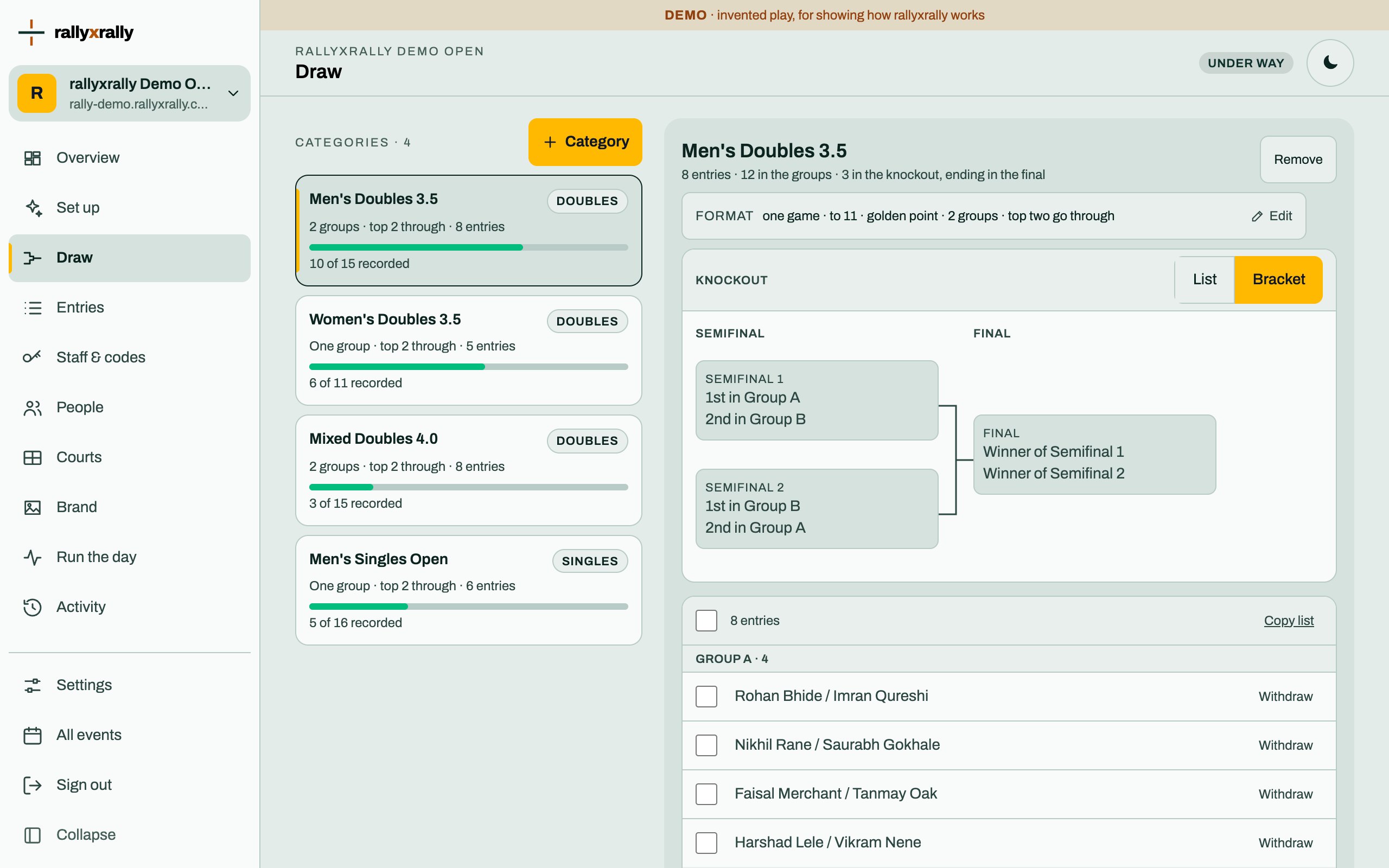
You choose how many groups there are and what happens after them: no knockout, only the winners go through, or the top two. rallyxrally then seeds the group winners first and the runners-up next, in group order, and lays them out in the standard bracket so that the two from one group are on opposite sides.
Two groups, top two through gives semifinals with nobody meeting a group-mate:
| Match | Opponents |
|---|---|
| Semifinal 1 | A1 v B2 |
| Semifinal 2 | B1 v A2 |
| Final | Winner 1 v Winner 2 |
Four groups, top two through gives quarterfinals:
| Match | Opponents |
|---|---|
| Quarterfinal 1 | A1 v D2 |
| Quarterfinal 2 | D1 v A2 |
| Quarterfinal 3 | B1 v C2 |
| Quarterfinal 4 | C1 v B2 |
The winners of quarterfinals 1 and 2 meet in semifinal 1, and the winners of quarterfinals 3 and 4 in semifinal 2. Here A1 means the winner of group A and D2 the runner-up of group D.
Three groups, top two through shows what an odd number does. Six qualifiers do not fill a bracket of eight, so A1 and B1 get byes into the semifinals, and the first round has A2 v B2 and C1 v C2, two players from the same group meeting straight away. rallyxrally tells the organizer when a draw does this, because the only fix is a different number of groups. Choose a number of groups that gives 2, 4, 8 or 16 qualifiers where you can.
Because the draw is made from the entries, it changes when they do: a late entry changes its group, and changing the number of groups moves every place in the knockout.
Choosing a format
- Round robin guarantees everyone several matches, which suits social and junior events, and it is fair when entries are few. It needs more matches and more time.
- Knockout is quick and decisive, but half the field is out after one match.
- Groups then a knockout gives everyone a few matches and still ends with a final.
- How long will it take? The matches in each group are in the table above. Add them up across your groups, divide by the number of courts, and multiply by how long one match takes at your event. Match length depends on your scoring format and your players, so use your own figure.
What this page does not cover
- Seeding from ratings. The rulebook has a draw and seeding committee rank the players (12.D). rallyxrally seeds the knockout from where entrants finished in their groups and does not use a rating or a ranking. The organizer puts people into groups.
- Consolation, double elimination and back draws. The rulebook describes them (12.C.1, 12.C.3); rallyxrally does not run them.
- Team events. A team tie is several matches and has its own setup and tie-breakers.
- A substitute for the rulebook. For a ruling, use the USA Pickleball rulebook, and ask your tournament director which format and tie-breakers the event uses.
How to set a draw up is in Categories and the draw. Scoring a match is in how pickleball scoring works, and the rest of running an event is in pickleball tournament software.