How to keep score in pickleball, rule by rule
How pickleball scoring works: who can score, how to call the score in singles and doubles, how a game is won and when to change ends, with the rule numbers.
Every rule here is from the USA Pickleball 2025 Official Rulebook, and its number is in brackets so you can look it up. We checked each one against the rulebook on 2 November 2026, and we cite rather than recall, because a scoring rule remembered slightly wrong is how a match is lost at 10-10.
Only the serving side scores
A singles player or a doubles team scores a point only while serving (4.F). A point is scored by serving the ball and winning the rally (4.G). If the receiving side wins the rally, it does not score: it wins the serve, which the rulebook calls a side out (3.A.41).
So a game can be a long run from the server, or the serve can change hands several times without anyone scoring.
How a game is won
Typically, the first side to score 11 points and lead by at least two wins (Section 1). For tournaments the rulebook recommends best two of three games to 11, win by two. The other options are best three of five games to 11, one game to 15, or one game to 21, and all formats win by two points. A round-robin bracket with six or more teams may also play one game to 11, win by two (12.B).
The first side to score the winning point wins the game (4.H).
Calling the score in singles
The score is two numbers, the server's score, then the receiver's: "one, zero" (4.I).
In singles, the server serves from the right side when their own score is even (0, 2, 4…) and from the left when it is odd (4.B.5). The server keeps serving, alternating sides after each point, until they lose a rally or fault, and then the serve goes to the opponent (4.B.3, 4.B.4, 4.B.5.c).
Calling the score in doubles
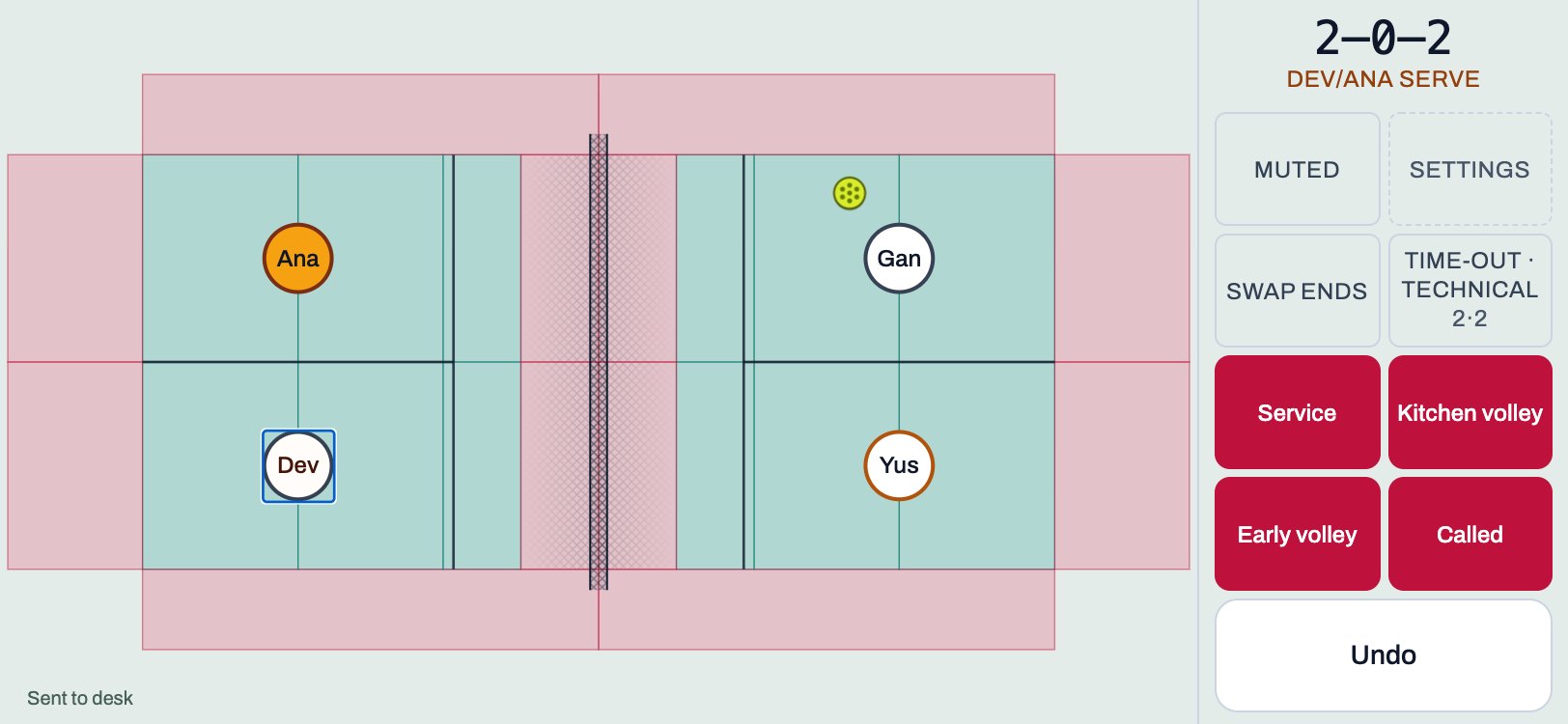
The score is three numbers: the serving team's score, the receiving team's score, then the server number, one or two (4.J). The rulebook's own example is "zero – one – one".
Both players on a team serve before a side out, with one exception: at the start of each game only the starting server serves (4.B.6). That starting server counts as the "Second Server" for scoring, which is why every game starts at zero – zero – two (4.B.6, 4.J).
After a side out, service begins from the right/even side, with the player who is correctly positioned there according to the team's score. That player is the First Server, and their partner the Second Server (4.B.6.a, 4.B.6.c, 3.A.13, 3.A.36). The First Server serves, alternating sides after each point, until their team loses a rally; then the Second Server serves from their correct position (4.B.6.d, 4.B.6.e).
A game, call by call
Team A serves first. Here is how the call changes, with the rule behind each step:
| What happens | The call | Why |
|---|---|---|
| The game starts | 0 – 0 – 2 | Only the starting server serves, counted as second server (4.B.6, 4.J). |
| A loses the rally | 0 – 0 – 1 | Side out. B's player on the right/even side is First Server (4.B.6.c). |
| B wins the next rally | 1 – 0 – 1 | The serving team scores (4.F). The server changes sides (4.B.4). |
| B's First Server loses a rally | 1 – 0 – 2 | Both players on a team serve before a side out (4.B.6.e). |
| B's Second Server wins one | 2 – 0 – 2 | The serving team scores. |
| B's Second Server loses a rally | 0 – 2 – 1 | Side out. A is now serving, so A's score is called first: A has 0, B has 2 (4.B.6.c). |
When the serving team's score is even, the starting server is in the right/even court; when it is odd, in the left/odd court (4.B.6.b).
Calling the score before every serve
The entire score must be called before the ball is served (4.A.1). It is called once the server and receiver are, or should be, in position and everyone is ready (4.D). In a match with a referee, the referee confirms that everyone is in the correct position and the correct server has the ball before calling it (4.B.9). In non-officiated play the server normally calls it (4.D.1).
Once the score has been called, the server has 10 seconds to serve, or it is a fault (4.E). If the wrong score is called, the referee or any player may stop play before the return of serve, and the rally is replayed with the correct score (4.K).
Changing ends
Teams change ends and initial service after each game (5.B.1), and two minutes are allowed between games (5.B.2). In a single-game match, teams change ends at the midpoint: 6 in a game to 11, 8 to 15, 11 to 21 (5.B.3). In a multi-game match, ends change at the midpoint of the last game (5.B.4). The serve stays with the player who holds it.
Time-outs
A player or team is entitled to two time-outs in an 11- or 15-point game, and three in a 21-point game. Each lasts up to one minute (10.A, 10.A.1).
The rally scoring option
The rulebook also describes a provisional rally scoring option, which a tournament director may choose (12.B.1). Under it a point is scored on every rally won, except that game point can only be scored by the serving side (4.F.1, 4.G.1). In doubles one player serves before a side out, and the score is called as two numbers, as in singles (4.B.6, 4.J.1). For 2025, USA Pickleball Golden Ticket events and the National Championships use side-out scoring (12.B.1). If you are not told otherwise, expect the side-out scoring described above.
How rallyxrally keeps the score
It follows these rules for the scoring rules it implements, and it shows the score in the form it is spoken, such as 2-0-2. Tap it to hear it, or let it call the score before each serve. It offers the sanctioned formats above, and it also offers a few that local events use to stay on schedule, such as a cap or a golden point at 10-10. Those are named as what they are, not as the rulebook's. See how scoring works in the app and the three depths of recording.
What this page does not cover
- Faults and line calls. What counts as a fault, how a serve must be made, and the non-volley zone (kitchen) rules are in Sections 4.A, 4.M and 7 to 9 of the rulebook, not here.
- Wheelchair play and technical fouls, which have rules of their own.
- A substitute for the rulebook. This is a guide to the scoring sections. For a ruling, use the USA Pickleball rulebook, and ask your tournament director which rules and scoring option the event uses.
- Later editions. The rulebook changes. These rule numbers are from the 2025 edition.
Running an event? See pickleball tournament software.